
How to build a stronger back without deadlifts, swings or painful flexion.
What Is the Chinese Plank?
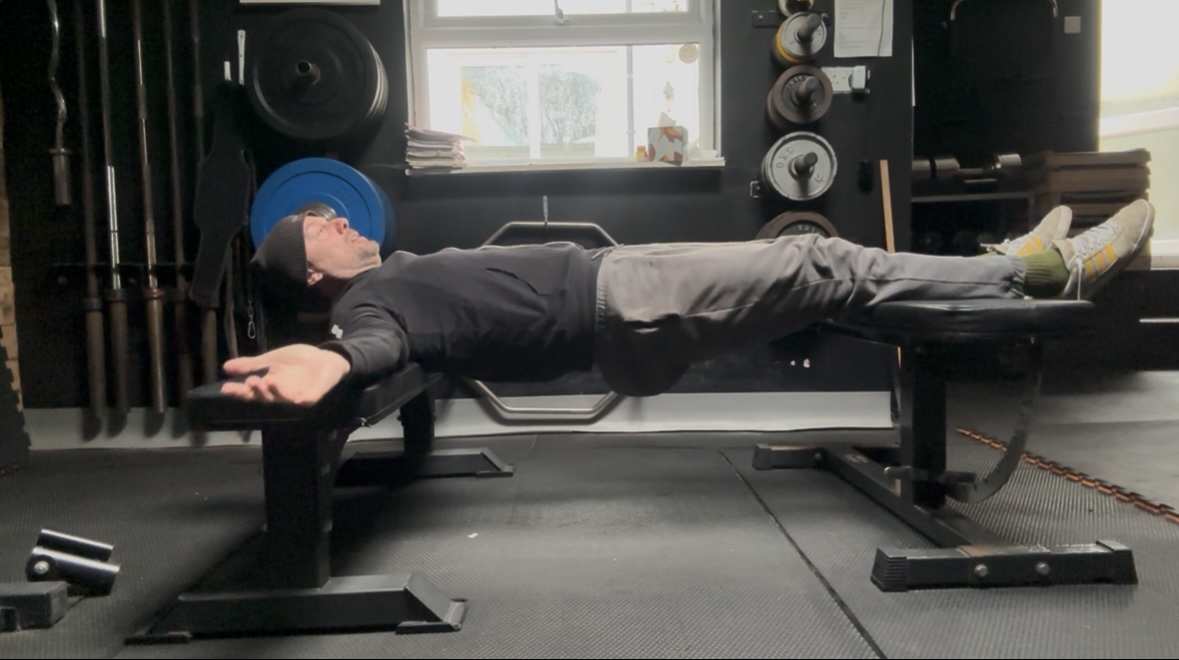
The Chinese plank is a powerful isometric strength exercise that trains the entire posterior chain — the muscles running from your shoulders all the way down to your heels.
Isometrics are a great option for anyone who experiences lower back pain since no movement occurs during the exercise.
Your upper back rests on one bench, your heels rest on another, and your hips are suspended in the middle. From there, your job is to create a straight, rigid “bridge” with your body and hold it.
It’s one of the most effective ways to build spinal stability, glute and hamstring strength, and whole-body tension without bending forward or loading the spine in positions that aggravate back pain.
For people who struggle with flexion intolerance (pain triggered by rounding forward), the Chinese plank can be a game-changer.
Side note – The Chinese plank is also sometimes referred to as the reverse plank. It got its name due to its popularity by Chinese weightlifting Strength coaches and athletes.
Video Demonstration
Why the Chinese Plank Works So Well
Most back issues aren’t solved by stretching — they’re solved by strengthening.
But not everyone can tolerate traditional strengthening exercises like:
- deadlifts
- kettlebell swings
- hyperextensions
- sit-ups
If these positions irritate the spine, you need a way to build strength without triggering pain.
The Chinese plank allows you to train:
- glutes
- hamstrings
- spinal erectors
- lats
- core
- upper back
…while keeping the spine in a neutral, safe, supported position.
It builds tension, stability, and confidence under load — which is exactly what many people with back issues are missing.
How to Perform the Chinese Plank (Step-by-Step)
1. Set up two benches
Place them roughly shoulder-width apart, or slightly wider.
Your upper back will go on one bench, your heels on the other.
2. Position yourself between the benches
- Upper back/shoulder blades on one bench
- Heels on the opposite bench
- Legs straight
- Arms either folded across the chest or by your sides
3. Lift your hips into a straight line
Your body should form a rigid bridge from shoulders to heels.
Look for:
- ribs down
- glutes tight
- quads and hamstrings engaged
- no sagging through the hips
- no flaring through the chest
4. Hold the position
Start with shorter holds and build up over time.
Progression comes from longer holds and additional load.
Common Mistakes to Avoid during the Chinese plank
❌ Hips too low
This reduces the tension through the posterior chain.
❌ Arching through the lower back
Keep ribs down and glutes squeezed.
❌ Pushing into the benches with your arms
Let your posterior chain do the work.
❌ Bending your knees
Straight legs ensure your heels take the load correctly.
Progressions and Regressions
Easier Options
- Reduce the distance between the benches
- Use shorter hold times
Intermediate Options
- Push the benches further apart
- Hold for longer (up to one minute)
Hard Options
- Add additional load across the hips
- Try one-leg versions (hold the other leg straight up in the air)
Who Is the Chinese Plank For?
This exercise is particularly useful for:
- people with flexion-intolerant back pain
- anyone who can’t deadlift or hinge pain-free
- beginners needing safe posterior chain strength
- athletes wanting more trunk stiffness and power
- people rebuilding confidence after injury
It’s a staple in my programming for clients who need strength without spinal aggravation.
What the Chinese Plank Helps Improve
- Low-back stability
- Glute and hamstring strength
- Isometric core strength
- Posterior chain coordination
- Confidence under load
- Movement tolerance
- Reduced back pain flare-ups
When someone masters this exercise, daily movements — bending, lifting, loading — all become easier and safer.
Want Help Using This in Your Own Training?
If you’re dealing with back pain, struggling with deadlifts or swings, or simply want to get stronger safely, this exercise can make a huge difference.
If you’d like guidance, book apersonal training session, get a free class pass for our Wednesday night strength session, join one of our strength and kettlebell classes in Bristol or simply send me a message and tell me what you’re dealing with. I’ll help you figure out exactly which exercises your body responds to best — just like I did with my client Dave Lee.