

When Dave Lee came to me, he’d been living with back pain for over 15 years. On a good day it sat around 5/10. On a bad day it would spike to a 10/10, the kind of pain that stops you in your tracks and makes you question every single movement.
His injury happened years earlier while lifting a heavy object out of the boot of his car. The moment he did it, he knew something was seriously wrong. He couldn’t stand up straight, had to be helped to the ground, and spent the early stages just trying to cope by combining ibuprofen and paracetamol — enough to take the edge off, but not a way to live.
Dave had tried everything most people typically try:
physio, yoga, painkillers, stretching — eventually an MRI.
The scan showed significant degeneration at L4/L5, plus further endplate changes and milder degeneration at L5/S1. In simple terms:
his lower spine had taken a beating over the years, and the structures in that area weren’t happy.
The clinical options he was given?
Injections or surgery. Neither addressed why his back struggled in the first place.
By the time he walked into the gym, even tying shoelaces or picking up something light felt risky. He’d begun organising life around pain avoidance.
Understanding his back pain: Flexion Intolerance
During his assessment it became obvious he was flexion intolerant.
Meaning:
Whenever he bent forward or rounded his spine, his symptoms were aggravated.
This instantly ruled out a lot of traditional strengthening approaches:
- deadlifts
- kettlebell swings
- hyperextensions
- sit-ups
- any form of loaded spinal flexion
So I needed another strategy — something that allowed him to get stronger without provoking the injured area.
Introducing the Chinese Plank (The Game-Changer for back pain)
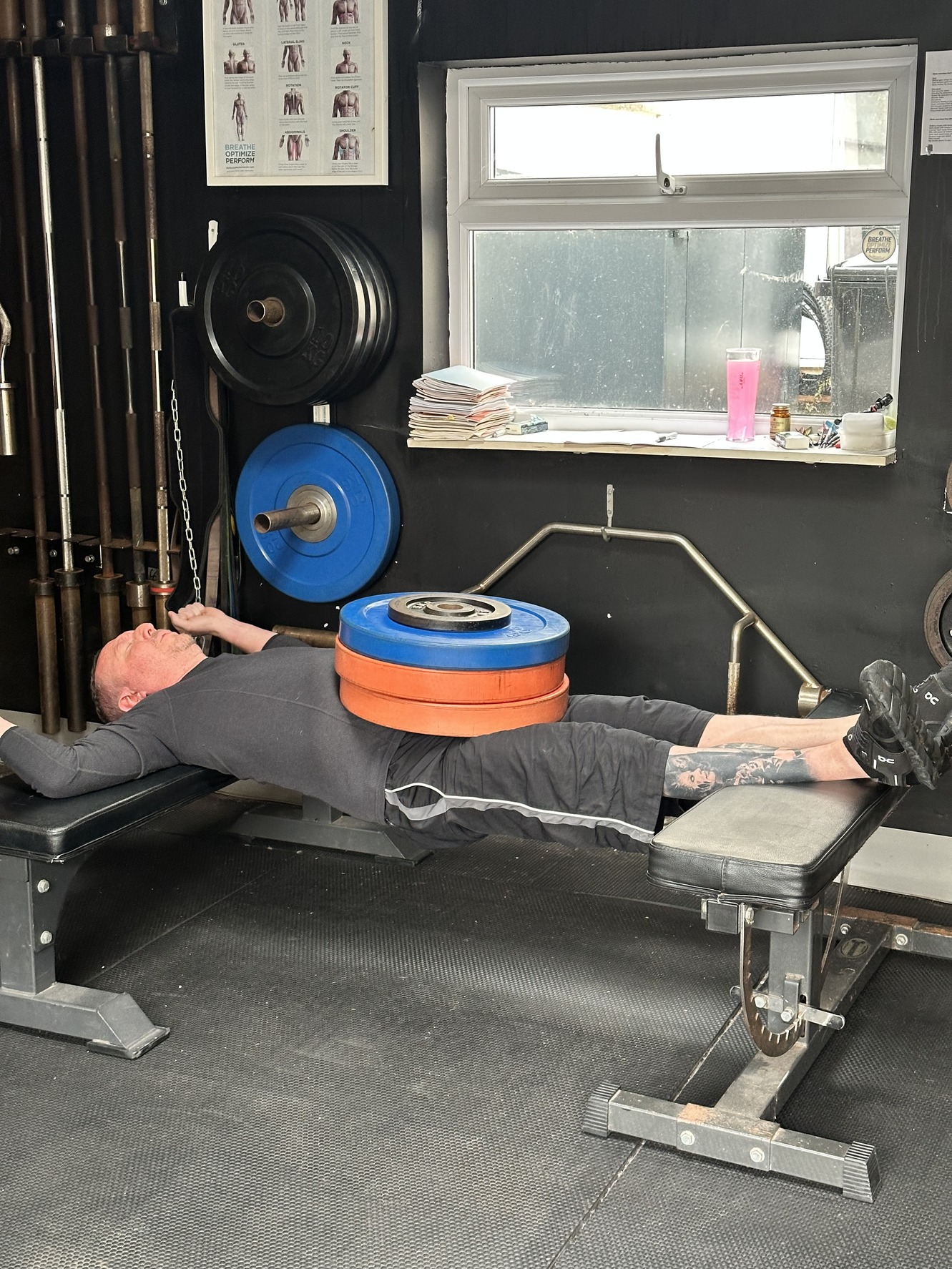
The exercise that became the turning point was the Chinese plank.
What is a Chinese plank?
It’s an isometric hold where your upper back rests on one bench and your heels on another, leaving your hips suspended in the middle. You create a straight, rigid bridge and brace your entire posterior chain — glutes, hamstrings, back, lats, core — to hold the position.
It lets someone build:
- stiffness
- strength
- stability
- confidence under load
…all without bending forward or stressing the spine in a way that irritates.
Once he mastered the basic position, we loaded it progressively. Eventually he was holding 85kg across his hips for a full minute — something unimaginable for someone who once struggled to tie his shoes.
He summed it up perfectly:
“Chinese planks with stupid amounts of weight! It’s been absolutely revolutionary for my back.”
This is in conjunction with a full body strength routine, that included squats, core exercises and pushing and pulling exercise.
Results from targeted strength work
Pain Levels
Before: 5–10/10
Now: “100% improvement… it’s no longer on my mind.”
Daily Life
He can now move freely and confidently:
- tying shoelaces
- picking up boxes
- pressing kettlebells
- bending forward
- loading the spine naturally
These things no longer come with hesitation or fear.
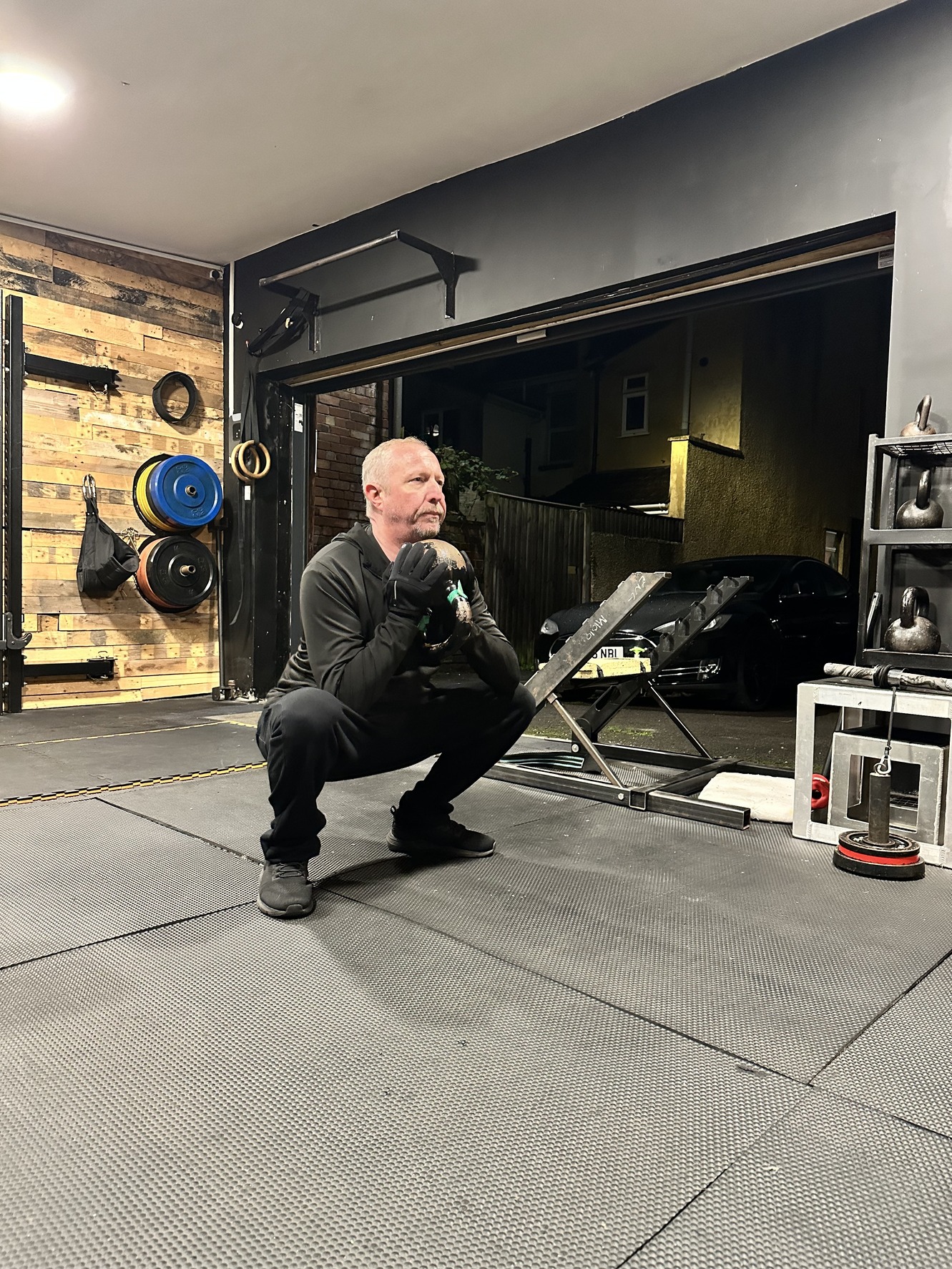
Strength
Holding 85kg in a Chinese plank for 60 seconds — incredible progress for someone who once relied on pain medication just to function.
If you are suffering with back pain and haven’t tried targeted strength training to address it, I can confidently say that you’re suffering unnecessarily. Dave is one of many people I’ve helped get back to normal daily activities through strength work.
For an informal chat to see if I can help you, please text or call me on 07800542416, alternatively come along to our Wednesday night strength class at Ashton park school. Its risk free as the first session is on the house with this free membership.